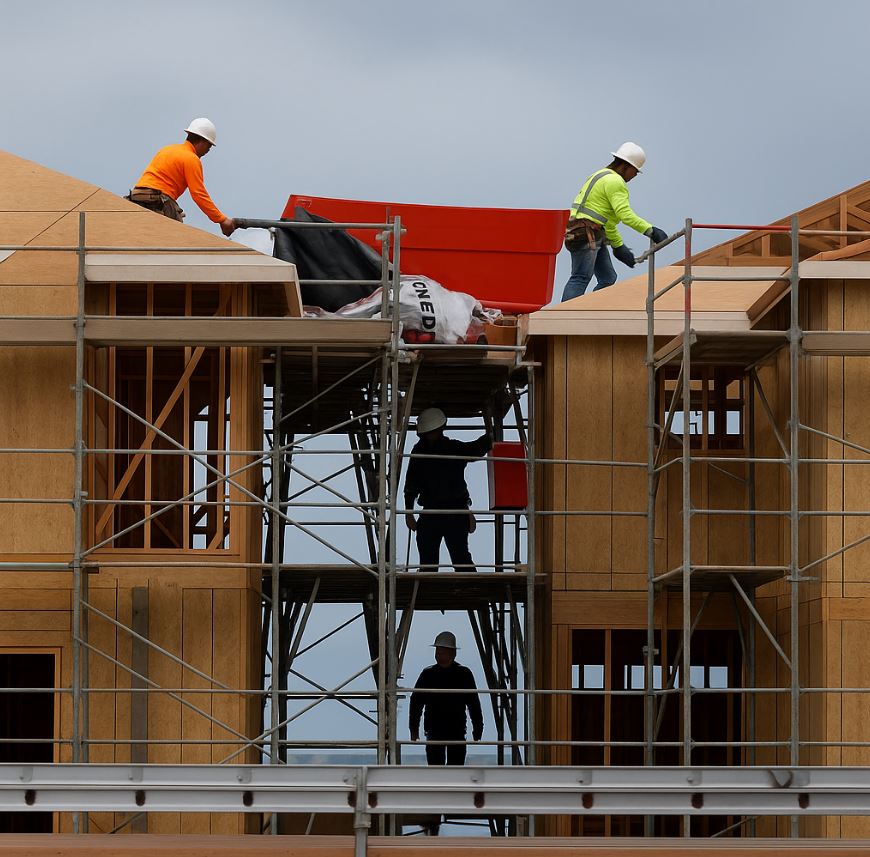
US construction spending unexpectedly declined in March, and the country’s manufacturing sector continued its downward slide in April, as rising tariffs and high borrowing costs put pressure on builders and factory output.
The data points to growing concerns about the strength of the US economy amid persistent inflationary pressures and trade tensions.
According to the US Commerce Department’s Census Bureau, construction spending fell by 0.5% in March, reversing the 0.6% gain recorded in February (revised from an earlier estimate of 0.7%).
Economists had expected a modest 0.2% rise, making the drop a surprise for markets.
U.S. construction spending dipped in March:
📉 Total: $2.20T (-0.5% MoM)
▫️Private: $1.69T (-0.6%)
▫️Residential: $937.7B (-0.4%)
▫️Nonresidential: $750.3B (-0.8%)
▫️Public: $508.1B (-0.2%)
📈 Still up 2.8% YoY and 2.9% YTD.
On an annual basis, construction spending was still up 2.8% compared to March 2023.
Private construction, which accounts for the majority of overall spending, saw a 0.6% decline.
Within the sector, residential construction dipped by 0.4%, although spending on new single-family homes rose slightly by 0.1%.
Investment in multi-family housing projects remained unchanged during the month.
High mortgage rates and increased material costs, driven in part by tariffs, continue to weigh heavily on the housing market.
The National Association of Homebuilders recently estimated that new tariffs—including a 145% duty on Chinese goods and a 25% levy on foreign steel and aluminum—have pushed construction costs up by approximately $10,900 per home.
Private non-residential construction, which includes commercial projects like offices and factories, fell by 0.8%, suggesting broader caution among developers and businesses.
Public construction projects also recorded a modest decline, with overall spending easing 0.2%.
State and local government outlays dropped 0.2%, while federal construction spending was down 0.4%, signaling a slight pullback in government-funded infrastructure activity.
US manufacturing struggles in April
The Institute for Supply Management (ISM) reported that its manufacturing Purchasing Managers’ Index (PMI) fell to 48.7 from 49.0 in March, the lowest level in five months.
A reading below 50 indicates contraction. The manufacturing sector makes up about 10.2% of the U.S. economy.
The downturn followed former President Donald Trump’s “Liberation Day” announcement, which imposed sweeping tariffs on imports, particularly Chinese goods, further straining already fragile supply chains.
Manufacturers, heavily reliant on imported raw materials, are now facing higher input costs and longer delivery times.
US manufacturing flatlined in April: PMI stuck at 50.2, output down, exports slump on tariff impact. Costs surge, confidence drops to 10-month low. Firms hike prices & cut staff to protect margins. Inflation & trade risks cloud outlook. #PMI #Manufacturing
The ISM’s forward-looking new orders sub-index slightly improved to 47.2 from 45.2, offering a glimmer of hope.
However, production levels remained subdued, and the supplier deliveries index jumped to 55.2 from 53.5, signaling slower delivery times.
Prices paid by manufacturers rose to 69.8—the highest since June 2022—suggesting renewed pressure on goods inflation.
Factory employment remained weak, with the ISM employment index rising slightly to 46.5 from 44.7, still firmly in contraction territory. Imports into the manufacturing sector also declined for the first time since December, reflecting reduced demand and trade disruptions.
Together, the weak construction and manufacturing data point to cooling economic momentum as higher tariffs, rising material costs, and tight monetary policy continue to impact investment and production.
The post US construction spending slips in March, manufacturing slump deepens in April amid tariff headwinds appeared first on Invezz