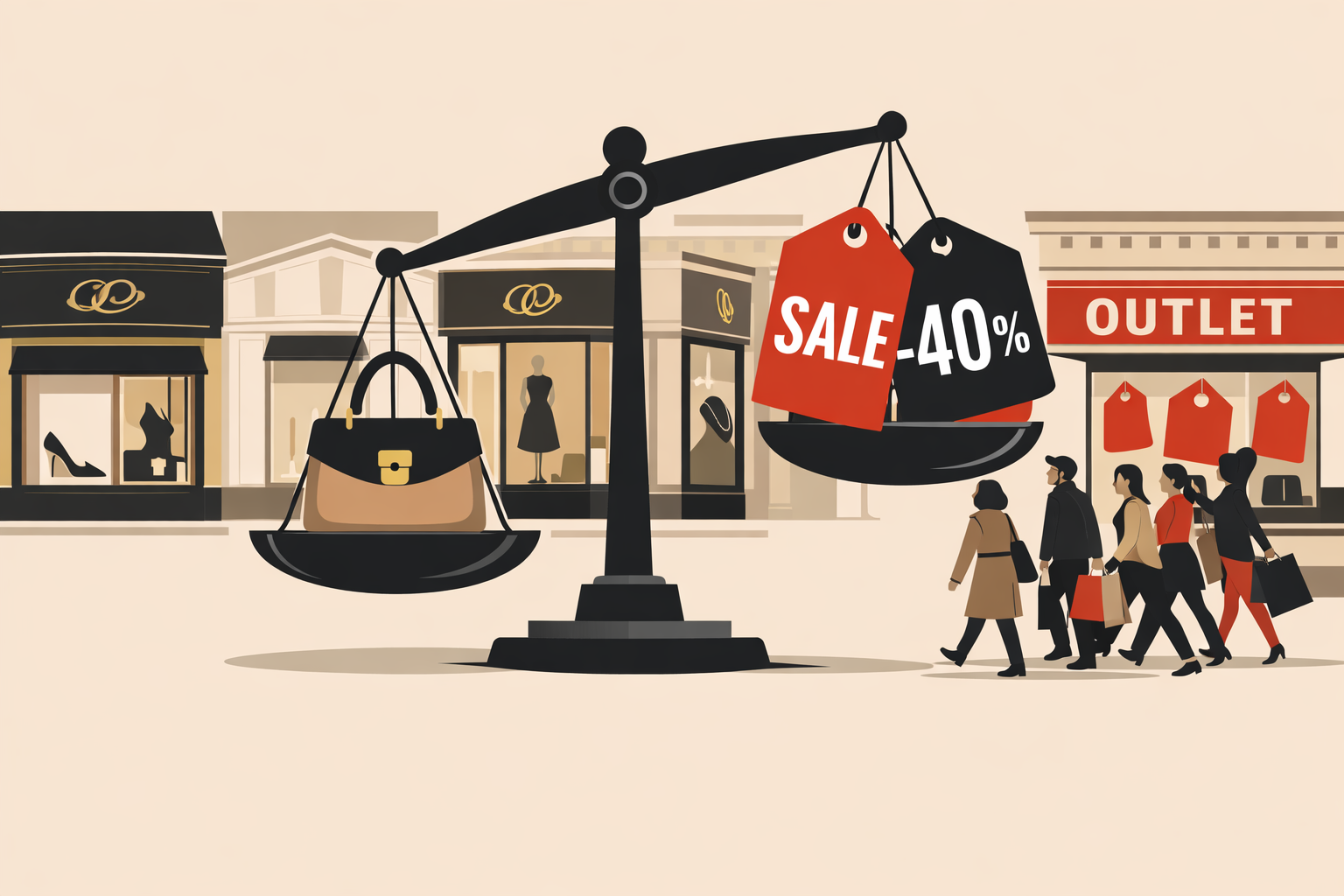
Luxury goods companies are facing renewed pressure on profitability after a sharp rise in discounting during 2025, as consumers increasingly question the value of high-end products following years of aggressive price increases.
Industry data shows that as much as 40% of luxury goods were sold at discounted prices last year, undermining margins across the sector, said a FT report.
According to consultancy Bain and Italian luxury industry association Altagamma, around 35 to 40% of luxury products were sold at knockdown prices in 2025, up by at least five percentage points compared with a decade earlier.
This growing reliance on discounts has pushed industry margins to their lowest level in 15 years, excluding the Covid-19 period, amid a broader slowdown in demand for designer goods ranging from shoes to handbags.
Consumers are increasingly choosing outlet stores over full-price purchases in boutiques, signalling a shift in buying behaviour.
While some discounting also occurs in luxury brands’ own stores, it remains less common for top-tier labels that have historically sought to tightly control pricing and brand positioning.
“When consumers step back from paying full price, it is less a sign of frugality and more a clear message that the price-to-value equation in luxury has drifted out of balance,” said Claudia D’Arpizio, Bain’s global head of luxury.
Post-pandemic price hikes test consumer tolerance
Luxury groups raised prices sharply during the post-pandemic sales boom, helping to boost profitability in the short term.
According to Bain, prices on many luxury products are now between 1.5 and 1.7 times higher than they were in 2019.
However, the industry’s pipeline of new hit products has thinned, making it harder for brands to justify these elevated price points.
The growing reliance on discounts presents a challenge for an industry that has spent years trying to reduce its exposure to wholesale and discounted sales channels to retain control over how products are priced and presented.
Industry buyers are already adjusting their strategies in response.
“My customers are turning to contemporary brands or emerging designers, where the fashion content is high but the price point is lower than the big luxury names. So that’s where I’m putting more budget,” said a buyer at a big European department store in the report.
Luxury houses have recently introduced a new generation of creative directors at brands including Gucci, Chanel, and Dior, a move that some believe could inject fresh energy into collections.
The same buyer said the changes should bring “new energy” to high-end design houses, but cautioned that the new designers still face a challenge.
“The early signs in terms of creativity are promising [but] we’ll have to see if it’s enough to justify the cost,” the buyer said, adding that the new arrivals still needed time to settle in before being able to build momentum behind so-called hero products.
Margins retreat as costs rise and spending tightens
The heavy discounting and slowing demand have taken a visible toll on profitability. Bain estimates that margins on personal luxury goods have fallen back to levels last seen in 2009.
Average operating margins peaked at 23% in 2012 and stood at 21% in 2021, but are expected to decline to around 15 to 16% in 2025.
Rising costs and the continued need to invest in marketing have added to the strain.
Several major luxury groups have responded by cutting costs and rethinking their global footprints.
Kering, the owner of Gucci and Saint Laurent, has been one of the sector’s weaker performers in recent years and is conducting a portfolio review under new chief executive Luca de Meo.
The group is looking to cut costs and scale back its retail network.
Market leader LVMH has also taken steps to rein in spending, including reducing marketing blitzes, cutting travel budgets, and closing underperforming stores, particularly in China.
At the same time, it has continued to invest in high-profile projects such as a large Shanghai flagship store shaped like a cruise ship, which opened last year.
Chanel reduced marketing spending and slowed hiring in China during 2025, the FT reported.
LVMH said it had “controlled non-priority costs and continued to invest in brand desirability, for example, with projects that surprise people just like The Louis did in Shanghai”.
There are tentative signs of stabilisation in China after two difficult years.
Sales of jewellery and luxury experiences, including travel and dining, have remained relatively resilient.
“After the shopping spree era, experiences and emotions have become the true engine of luxury growth,” D’Arpizio said.
The post Luxury brands face profit squeeze as discounting soars and shoppers question value appeared first on Invezz