INGLEWOOD, CA. — The savior of the NBA All-Star Game wasn’t Adam Silver, or whichever league exec came up with the revised “U.S. vs. World” format, or even the format itself.
It was a 7-foot-4 French phenom who, through stubborn persistence, forced the hands of the world’s best basketball players to give more.
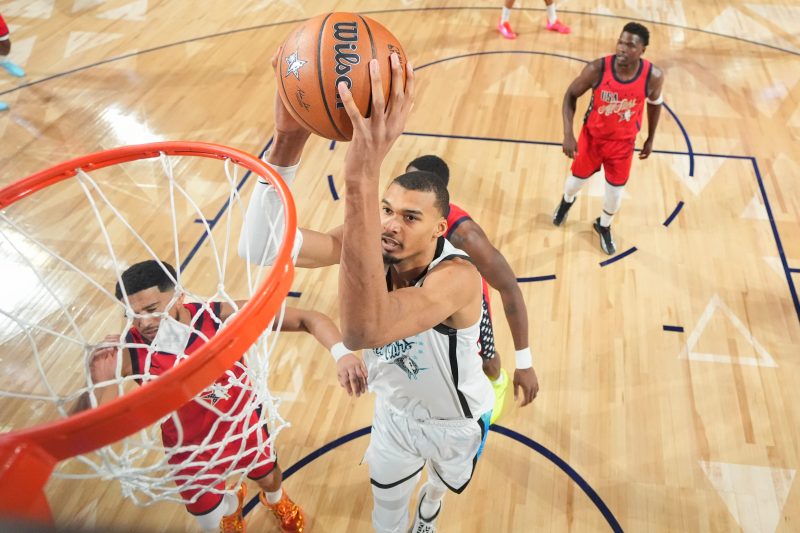
Victor Wembanyama swatted the opening tip off to teammate Jamal Murray and sprinted until he got underneath the rim. He sealed off Cade Cunningham and begged for the ball. Murray whipped a pass that Wembanyama — seemingly in one single motion — caught on ascent to the rim before flushing a forceful dunk.
“He set the tone, man, and it woke me up,” Timberwolves guard Anthony Edwards, the eventual All-Star Most Valuable Player, told reporters after the event. “For sure.”
After Silver, the NBA commissioner, and the league overall faced repeated criticism over insipid All-Star Games that desperately lacked competitive play, Wembanyama’s competitive spirit saved the event this year, with the potential to carry it beyond. Wembanyama just turned 22 and made his second All-Star appearance in his third season. Undeniably one of the elite players in the world, Wembanyama is about to become a fixture — the fixture? — in NBA All-Star Games. And he proved Sunday, Feb. 15 that, with him as the steward of competition, the All-Star Game may just be sustainable after all.
To be sure, the format does deserve some credit.
Creating the four, 12-minute games essentially compressed play, converting each game into its own fourth quarter, elevating the stakes in the final minutes.
Tapping into national pride did appear to motivate players, but several said before and after the All-Star Game that they missed the East vs. West structure as well.
The 2026 All-Star Game worked, however, because players bought in and chose to push themselves.
The first three games were decided on the final basket, by a combined seven points. The first contest went into overtime. And as the prospect of winning crept in, teams intensified their defense.
All month long, Wembanyama had been saying that he wanted to lead the charge in forcing the world’s best basketball players to compete with organic intensity in the All-Star Game. It became a point of pride.
Consider his comments Saturday, when asked how, specifically, he planned to will his competitive vision onto other players.
“I think exclamation-point plays, playing in a solid manner and sharing the ball with energy,” Wembanyama said then. “If you share that energy, people feel like they have a responsibility to share it back to you.
“I’m confident in the way it’s going to go.”
Like Kobe Bryant before him, Wembanyama is bearing the standard, being the one outlier to demand more from his contemporaries.
Consider this: as Wembanyama was setting the tone six seconds into the event, Cavaliers guard Donovan Mitchell and his Team Stripes teammates were staying warm in an auxiliary gym here in the Intuit Dome, awaiting the winner of the first game.
Naturally, the All-Star Game was playing on the flatscreen in the corner. But even then, Wembanyama’s reputation preceded more than his play did.
“I’m not going to lie, I was working out when they were playing, so I didn’t really watch much of it,” Mitchell said. “But I already knew just from last year being on his (All-Star) team that he was going to come out and set that tone. He’s shown that’s who he is, and if you have a guy like that coming for everybody, it makes everybody kind of get going.”
Now, if Wembanyama was the savior of the All-Star, Edwards, Jamal Murray, Kawhi Leonard and several others were his accomplices.
Edwards scored 32 points across three games. Murray dished out 8 assists in two contests. Leonard erupted for a historic 31 points in Game 3 — essentially surpassing his season scoring average (27.9) in a 12-minute quarter.
But no player showed the irrational, maniacal fire that Wembanyama did, and, true to rigid competitors, that was most evident when things didn’t go well.
In Game 1, in overtime, a defensive rotation error led to Team Stars forward Scottie Barnes being wide open for the game-winning 3. Once it fell through the net, Wembanyama was visibly upset and yelled to himself, gesturing with his hands. He took a solitary lap around the floor. He walked off looking as if the Spurs had lost an important game.
“We had already conceded a 3 when we should have stayed home,” Wembanyama lamented later. “What we were saying was ‘No 3s, no 3s,’ because that’s what they needed twice in the game.
“So it’s disappointing.”
Yes, the future of the NBA All-Star Game is in good hands.