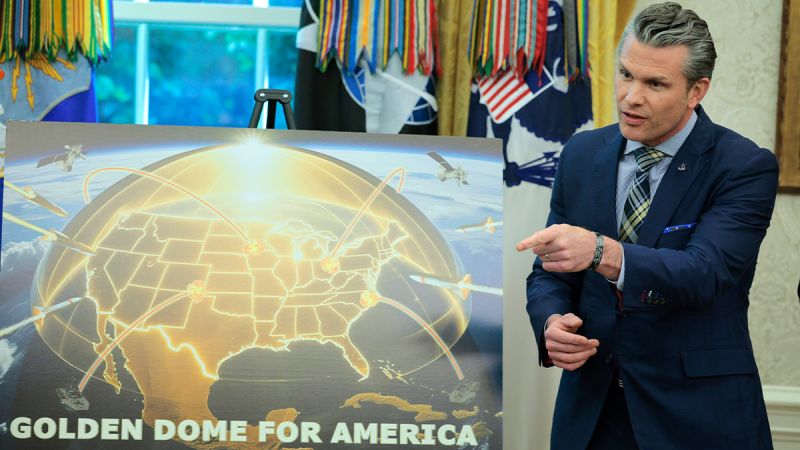
The debate over U.S. missile defense is increasingly focused on space, and defense experts argue that stopping threats in the earliest moments after launch could determine whether the homeland remains protected against Russia and China’s expanding arsenals.
At a policy discussion marking roughly a year since the rollout of the ‘Golden Dome’ homeland defense initiative, former senior defense officials said the United States can no longer rely primarily on deterrence and retaliation to shield the country from missile attacks.
‘I think geography is no longer’ a shield, former Air Force Undersecretary Kari Bingen said during a C-SPAN panel Friday. ‘There are different types of threats that can reach the homeland.’
The Golden Dome initiative stems from a January 2025 executive order signed by President Donald Trump directing the Pentagon to accelerate development of a next-generation homeland missile defense architecture. The order calls for integrating existing ground-based interceptors with advanced tracking networks, new space-based sensors and potentially space-based interceptors capable of detecting and defeating ballistic, cruise and hypersonic missile threats earlier in flight.
Administration officials have framed the effort as a response to rapid modernization by Russia and China.
Russia has fielded new intercontinental ballistic missiles and hypersonic glide vehicles designed to penetrate missile defenses, while China has expanded its nuclear arsenal and constructed hundreds of new missile silos in recent years.
Both countries have invested heavily in maneuverable reentry vehicles and countermeasures intended to complicate U.S. interception efforts.
Stopping missiles early
Supporters of a stronger space layer argue that intercepting a missile early in flight — before it can deploy warheads or countermeasures — simplifies the defensive challenge and reduces the strain on systems closer to U.S. territory.
‘It gives the ability to neutralize before they manifest here at home,’ missile defense expert Thomas Karako said, referring to space-enabled capabilities that could track and potentially intercept threats sooner in their trajectory.
Karako said there is ‘a compelling case’ for space-based interceptors ‘not just against nonnuclear attack but even limited nuclear attacks,’ arguing that raising the threshold for adversaries contemplating a strike strengthens deterrence overall.
‘If you raise the threshold for having enough capability to meaningfully invest in enemies … there’s goodness in there,’ he said.
Panelists emphasized that the objective is not absolute protection against thousands of intercontinental ballistic missiles, but improving the odds of defeating smaller or more limited attacks, including those that could involve large salvos or advanced countermeasures.
Threats are evolving
Melissa Dalton, a former senior Pentagon official, said missile and drone use has become increasingly normalized in recent conflicts, lowering the perceived threshold for employment.
‘They don’t respect the boundaries,’ Dalton said, noting the growing frequency of missile and drone attacks.
Bingen argued that the U.S. historically leaned heavily on the threat of retaliation to deter attacks but that changing technologies and adversary capabilities require a broader approach.
‘Americans would be surprised how reliant we have been on vulnerability and retaliation,’ she said.
Space and integration challenges
While space-based missile defense once drew skepticism due to cost and technical hurdles, Karako said advances in commercial launch and satellite technology have changed the feasibility calculus.
‘This is not the Soviet Union in the ’80s or the ’90s,’ he said. ‘The technology has evolved quite a bit.’
Still, experts acknowledged that integration — linking sensors, interceptors and command-and-control systems at machine speed — may be the most difficult challenge.
‘We have to remember this is a layered defense system,’ Bingen said. ‘We’re not asking the space layer to do it all.’
Participants also stressed that any major expansion of homeland missile defense will require bipartisan political support to endure through election cycles and shifting budget priorities.
‘If you don’t persuade people what it’s about, it will never be built,’ Karako said.
Officials have floated an aggressive timeline — including a three-year push to stand up initial capabilities — but the Golden Dome is still in early development, with much of the work focused on planning, prototypes and initial contracts. Significant technical and acquisition hurdles remain, particularly for any space-based interceptor layer, which defense officials acknowledge would take years to fully field.
The effort marks a broader shift in how the U.S. approaches homeland defense. Rather than relying mainly on midcourse interceptors and the threat of retaliation, Golden Dome is designed to push defenses earlier in a missile’s flight — and further into space — with the goal of stopping threats before they can deploy countermeasures or overwhelm existing systems.