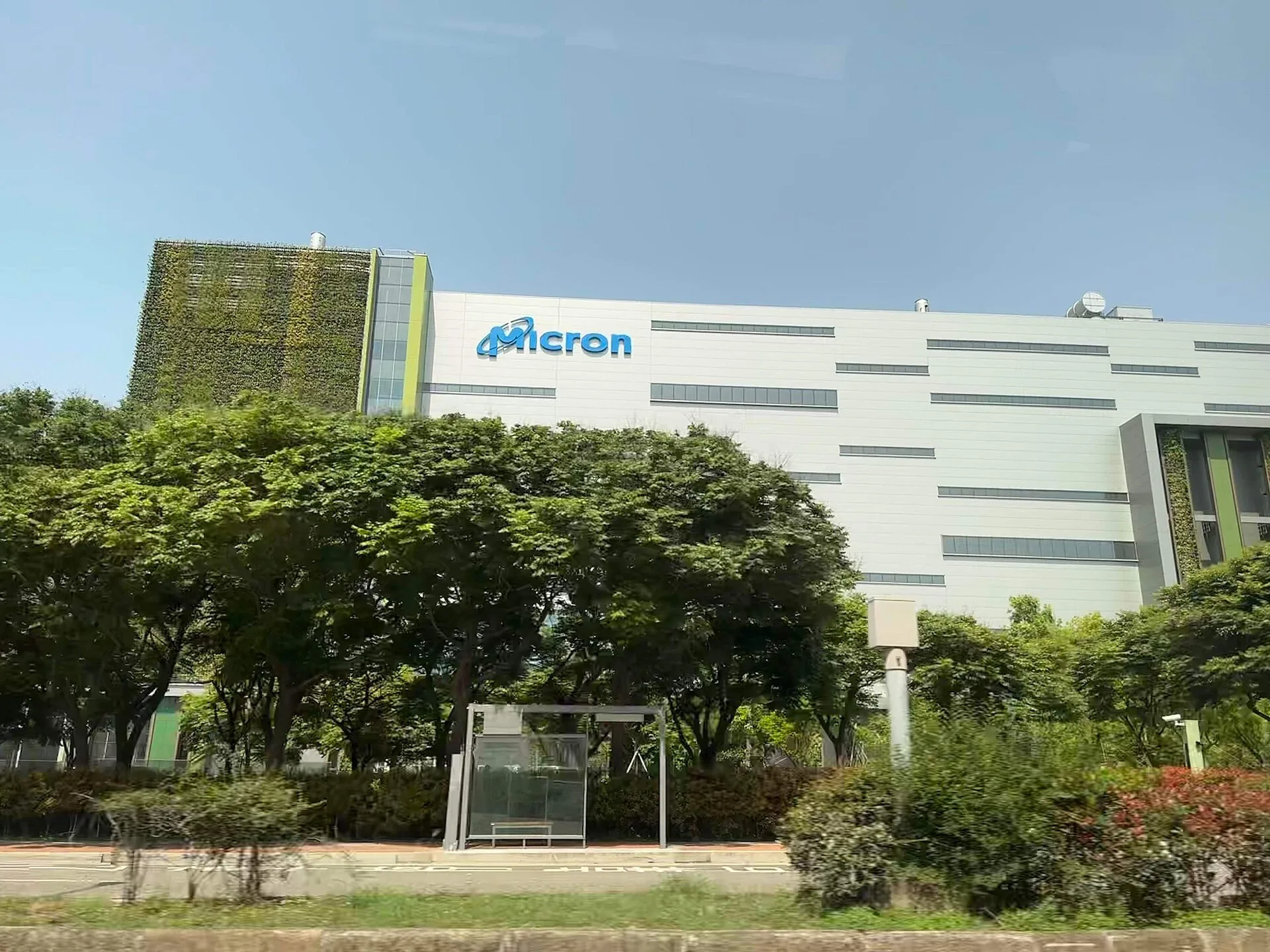
The common read on Micron is that its revenue has become as safe as a bond. The contracts say something narrower. Micron Technology’s 16 strategic customer agreements carry a minimum-price revenue value of about $100 billion across 14 of the deals, but that floor is spread over terms running to the end of 2030. That works out to roughly $22 billion a year, or about 12% of the $186 billion annual revenue run-rate implied by the company’s own fiscal fourth-quarter guidance. Micron stock (MU) closed at $1,082.28 on Friday 25 September 2026 (Nasdaq), up 279.2% this year and 10.8% below its 25 June record close of $1,213.56. Ahead of Wednesday’s fiscal Q4 report, our Micron stock prediction to 31 March 2027 is a $1,440 bull case, a $1,116 base case and a $660 bear case. Each is earnings times a multiple, shown below. The risk is not demand; it is what investors will pay for earnings still mostly exposed to market prices.
The market data points the same way. On Polymarket, traders give a 96.9% chance that Micron beats a non-GAAP earnings-per-share (EPS) line of $32.22, which sits above the top of the company’s own guidance range. Yet the stock is only 3.2% above its $1,048.51 close on 24 June, before Micron guided to a 20.6% revenue jump. Since June, Micron’s earnings have kept rising while the price investors pay for each dollar of those earnings has fallen. On the trailing quarter annualised, the multiple was 12.1x at the June peak. On the fiscal Q4 run-rate it is now 9.4x. Investors are not doubting the beat; they are doubting how long profits this high can last, and the contracts only partly answer that. Their largest versions set a ceiling near second-quarter 2026 market prices as well as a floor. That limits upside on the contracted volume while leaving most revenue exposed to the market.
Key Facts: Micron (MU) ahead of fiscal Q4 2026
- Fiscal Q4 guidance: revenue $50.0bn ± $1.0bn, non-GAAP gross margin about 86%, non-GAAP EPS $31.00 ± $1.00 — Micron Q3 FY26 release, 24 Jun 2026
- Fiscal Q4 is a 14-week quarter; fiscal 2026 has 53 weeks — Micron Form 10-Q, filed 25 Jun 2026
- Fiscal Q3 revenue $41.46bn, up 346% year on year; non-GAAP gross margin 84.9%; non-GAAP EPS $25.11 — Micron, 24 Jun 2026
- 14 of 16 strategic customer agreements carry about $100bn of cumulative revenue at minimum price — Micron Q3 slides via Investing.com, 24 Jun 2026
- Remaining performance obligations were only about $5bn at 28 May 2026, before most deals were signed — Micron 10-Q, Note 14
- MU closed at $1,082.28 on 25 Sep 2026: +279.2% year to date, −10.8% from the $1,213.56 record close — Nasdaq
- Polymarket gives a 96.9% chance of a beat against $32.22 non-GAAP EPS, on only $5,238 of volume — Polymarket, pulled 28 Sep 2026
What is actually happening at Micron, and why the extra week matters
Micron’s revenue has gone from a record to a larger record each quarter this fiscal year. It reported $13.64 billion in fiscal Q1, according to TrendForce’s December 2025 summary, then $23.86 billion in Q2 and $41.46 billion in Q3, according to Micron’s 24 June release. Guidance for Q4 is $50.0 billion, plus or minus $1.0 billion. Price did most of the work: the 10-Q shows that Q3 DRAM sales rose 67% on the quarter, from average selling prices up in the low-60% range while bit shipments rose only in the low single digits. NAND sales rose 99% on selling prices up in the mid-80% range.
The Q4 headline includes a calendar effect. Micron’s fiscal year ends on the Thursday nearest 31 August, so some years run 53 weeks, and the 10-Q says that “the fourth quarter of 2026 contains 14 weeks”. Once the extra week is taken out, the guidance midpoint equals $46.4 billion on a 13-week basis ($50.0bn × 13/14). That is 12.0% above Q3, not the 20.6% the headline implies. The EPS guidance midpoint of $31.00 becomes $28.79 per 13 weeks, or $115 a year. At Friday’s close that is 9.4 times run-rate earnings. We worked through the calendar effect in detail in our preview of the Micron earnings date and the extra-week $50bn guide.
Micron’s own gross-margin guidance shows the same slowdown. The non-GAAP gross margin rose from 74.9% in Q2 to 84.9% in Q3, a ten-point jump. Guidance for Q4 is about 86%, an increase of roughly one point. According to a GuruFocus summary of the Q3 call, management said the Q4 margin outlook reflects a moderation in the rate of price increases. Prices are still rising, but more slowly.
Think of a tollbooth on a congested road. Micron runs one of three major lanes into AI memory, alongside SK hynix and Samsung, and its charges have tripled because traffic outruns capacity. The strategic customer agreements work like season tickets: a guaranteed minimum from some regular drivers, in return for a cap on what the largest holders will ever pay. Everyone else pays the posted price on the day.
Chief executive Sanjay Mehrotra presented the agreements as a change in the business model. “We believe our multi-year Strategic Customer Agreements will significantly enhance the durability and predictability of Micron’s strong financial performance,” Sanjay Mehrotra, Chairman, President and CEO of Micron Technology, said in the fiscal Q3 release.
Quick Take: After removing the 14th week, the Q4 guide means 12% sequential growth, not 21%, and the margin gain shrinks from ten points to about one. Price increases are slowing, and that trend matters more than the size of the headline beat.
How customers, rivals and partners are responding
The strategic customer agreements are the clearest sign of customer demand, so their terms need to be precise. According to Micron’s Q3 slides, as reported by Investing.com, Micron has signed 16 agreements. They cover four very large, three medium-sized and nine smaller automotive customers. Most run five years, from calendar 2026 to the end of calendar 2030, while the automotive deals generally run three years. Together they cover about 20% of Micron’s DRAM volume and one-third of its NAND volume. Fourteen of the 16 carry about $100 billion of cumulative revenue at minimum price. Customers have committed $22 billion of deposits and related financial commitments, about $18 billion of it in cash.
The 10-Q adds the limits. The agreements are “take-or-pay”, with binding volume commitments. The largest “generally have a ceiling price for existing products that approximates the market price in the second calendar quarter of 2026, and a floor price through the term”. A minority float with the market. Micron says margins at floor prices should still beat its peak quarterly margins from any past cycle. Once all planned agreements are signed, the Q3 slides say contracts with fixed prices or ceilings at or near current market prices should account for about 40% of revenue.
Customers also locked in high-bandwidth memory (HBM), the stacked DRAM used alongside AI accelerators. In December 2025, TrendForce reported that Mehrotra had said pricing and volume agreements covered Micron’s entire calendar 2026 HBM supply, including HBM4. By June, the Q3 slides said the HBM4 12-high ramp was running about twice as fast as HBM3E 12-high, with more than $1 billion of HBM4 revenue already shipped.
SK hynix and Samsung compete for the same HBM sockets; see our SK hynix stock prediction and our Samsung stock prediction. Micron’s own supply additions arrive later than the current price peak. The 10-Q gives mid-calendar 2027 for first DRAM wafer output at the first Boise, Idaho fab and late calendar 2028 for initial output at the second Idaho fab. The Q3 slides put meaningful shipments from the acquired Tongluo site in Taiwan in mid-calendar 2027. Fiscal 2026 net capex is now guided at about $27 billion, up from $20 billion in December 2025.
On 15 September Micron said it had demonstrated a 512GB DDR5 RDIMM, a high-capacity server memory module, on multiple server platforms, with AMD and Intel validating it and volume production expected in the second half of 2027. “A 512GB RDIMM enables multi-terabyte servers, supporting larger AI and database workloads, greater virtualization density and improved power efficiency, all within existing server footprints,” Raj Narasimhan, senior vice president and general manager of the Cloud Memory Business Unit at Micron, said in the release. A large buyer backed the idea in the same release. “Higher-capacity memory technologies like Micron’s 512GB RDIMMs will help enterprises support larger in-memory workloads, improve resource utilization and enhance the flexibility needed to scale modern computing environments,” said Darrin Alves, chief information officer for Infrastructure Platforms at JPMorganChase.
Market impact and data: what $1,082 is pricing
Combining the filings with Nasdaq price history shows how investors value Micron’s earnings. EPS is non-GAAP; run-rates convert each quarter to 13 weeks and multiply by four.
| Measure | 24–25 June (Q3 print) | 25 September (now) |
|---|---|---|
| MU close | $1,048.51 pre-print; $1,213.56 record the next day | $1,082.28 |
| EPS basis | Q3 actual $25.11 → $100.44 a year | Q4 guide $31.00 → $28.79 per 13 weeks → $115.14 a year |
| Price-to-earnings multiple on that EPS | 12.1x at the record close | 9.4x (9.0x on the $32.22 Polymarket line) |
| Minimum-price contract revenue per year | About $100bn across ~4.5 years → ~$22bn a year | About 12% of the $185.7bn revenue run-rate |
| Recognised contract backlog (remaining performance obligations) | About $5bn at 28 May (10-Q) | About $100bn signalled for the Q4 disclosure |
The last row of that table matters for Wednesday. According to the GuruFocus call summary, finance chief Mark Murphy told analysts that Q4 would show a remaining-performance-obligation figure covering 14 of the 16 agreements, totalling about $100 billion. He said the next-12-months revenue from those deals would appear in the annual 10-K report. The 10-Q describes that obligation as a minimum based on committed volumes at minimum prices. It excludes the agreements without price bands. Once reported, the $100 billion moves from a slide into an audited filing, and the 12-month portion is the number to read.
Price action since June matches that reading. MU fell to a $926.55 close on 16 September, then rose 16.8% in seven sessions into Friday. Its 20-day realised volatility, calculated from Nasdaq closes, was 50.2% annualised. Polymarket’s October price markets are thin. With about $9,369 of liquidity and effectively no matched volume, they are sentiment, not an efficient price. They give 44.5% for a month-end close above $1,080, 28.5% above $1,200 and 15.5% for a touch of $1,500 during October. On the downside they give 45% for a dip to $900 and 20% for a dip to $780.
For NAND and storage pricing, where Sandisk and Western Digital are more exposed than DRAM-heavy Micron, see our Sandisk (SNDK) stock prediction and Western Digital (WDC) stock prediction. For the price path, TrendForce forecast NAND contract prices up 70% to 75% in Q2, with capacity relief years away.
Our Micron stock prediction: the arithmetic
Each case multiplies a 13-week run-rate EPS by four and then by a multiple. The run-rate starts at $28.79 from the Q4 guide midpoint.
- Bull, $1,440 (+33.1%): run-rate EPS rises 25% over two quarters to about $36 per 13 weeks, or $144 a year. That is slower than the 14.7% like-for-like gain from Q3 to Q4. At 10x earnings, $144 × 10 = $1,440. A 10x multiple still sits below the 12.1x paid at the June peak.
- Base, $1,116 (+3.1%): run-rate EPS reaches $31 per 13 weeks, or $124 a year, as price increases keep slowing. At 9x, close to today’s multiple, $124 × 9 = $1,116. Earnings grow and the stock goes nowhere, as it has since June.
- Bear, $660 (−39.0%): prices on the uncontracted volume slip, and run-rate EPS falls to $27.50 per 13 weeks, or $110 a year. That is 4.5% below the Q4 guide. The multiple then keeps compressing at the June-to-September pace of about 22% a quarter for two more quarters: 9.4 × 0.78 × 0.78 ≈ 5.7x, rounded to 6x because of the price floors. $110 × 6 = $660.
FinanceFeeds’ previous call on 5 September, made when MU had closed at $1,016.59 on 4 September, was a $1,500 bull case and a $560 bear case. The range is now narrower at both ends. The price-ceiling clauses cap our bull multiple, and the minimum-price commitments, audited from the Q4 filing, lift our bear floor.
Regulatory landscape and legal tension
Two legal matters touch Micron’s server business. First, as we reported, the ITC has opened a Netlist patent investigation into Micron memory products, numbered 337-TA-1523. It covers DDR5 registered and multiplexer-combined modules supplied by Micron and used by Supermicro, HPE and Lenovo. Netlist is seeking exclusion and cease-and-desist orders. “We intend to continue our enforcement efforts against unauthorized users such as Micron,” Netlist chief executive C.K. Hong said. An investigation is not a finding, but DDR5 RDIMMs are the family that includes the new 512GB module. The 10-Q separately lists Netlist suits over HBM and DIMMs in Delaware and Texas federal courts.
Second, Washington: CHIPS Act grants and tax credits help fund the Idaho and New York fabs. According to the Q3 slides, Micron intends to increase capital returns to shareholders after 9 December 2026, the second anniversary of its definitive CHIPS agreements. That is a buyback catalyst inside our scenario window. In New York, the 10-Q discloses a petition filed on 16 January 2026 in the Supreme Court of New York by Neighbors for a Better Micron and Jobs to Move America. It challenges the environmental review for up to four fabs in Clay and seeks to annul the permits. A ruling against Micron would delay supply for 2028 and beyond, not this quarter.
Disclosure is the third tension. Reported backlog is set to jump from about $5 billion to about $100 billion in one quarter, and the 10-Q warns that the obligation “is not expected to be indicative of future revenue under these contracts”. It is a legal minimum, not a forecast.
Quick Take: The ITC case affects the DDR5 RDIMM line, the CHIPS anniversary on 9 December could bring buybacks, and the New York petition affects supply from 2028 onwards. None of these changes Wednesday’s numbers, but each can change the multiple.
What happens next: three predictions
1. The beat is expected; the 12-month backlog figure is not. Polymarket’s 96.9% beat price, even on a thin $5,238 book, suggests a headline above $32.22 moves the stock very little. The figures that could move the price are the first audited contract backlog and its next-12-months portion. A near-term slice of $20 billion or more would put about a ninth of the current revenue run-rate under a contractual floor, which supports our base case or better.
2. The fiscal Q1 2027 margin guide sets the multiple. If Micron guides gross margin flat to lower from 86% on a normal 13-week quarter, the market will treat Q4 as peak earnings. The multiple would then keep sliding toward our 6x bear anchor into calendar Q1 2027. A guide above 86% makes 10x plausible.
3. Supply arriving in mid-2027 is the real test. Micron’s first Idaho fab and the Tongluo site both target mid-calendar 2027. Any repricing of uncontracted DRAM will show in contract-price surveys before Micron’s reported numbers. Our window ends on 31 March 2027, before that supply lands, so the bear case rests on anticipation, not arrival. Micron is more predictable than at any point in its history, but the stock now trades on how many years of peak earnings investors will count on, not on this quarter.
FAQ: Micron stock prediction and Q4 2026 earnings
What is the Micron stock prediction for 2027?
FinanceFeeds’ Micron stock prediction to 31 March 2027 is $1,440 in the bull case, $1,116 in the base case and $660 in the bear case, against a $1,082.28 close on 25 September 2026. The cases are annualised non-GAAP EPS times a multiple: $144 × 10x, $124 × 9x and $110 × 6x.
When does Micron report fiscal Q4 2026 earnings?
Micron reports fiscal fourth-quarter 2026 results after the US market close on Wednesday 30 September 2026,. Guidance is revenue of $50.0 billion ± $1.0 billion, gross margin of about 86% and non-GAAP EPS of $31.00 ± $1.00. The quarter contains 14 weeks rather than 13.
Why is Micron stock below its record despite expected record earnings?
Investors are paying less for each dollar of earnings. MU traded at 12.1x annualised Q3 EPS at its $1,213.56 record close on 25 June and at 9.4x the Q4 run-rate on 25 September. Slowing price increases and contract ceilings near second-quarter 2026 prices make investors doubt how long current margins last.
How much of Micron’s revenue is guaranteed by its customer agreements?
Fourteen of Micron’s 16 strategic customer agreements carry about $100 billion of cumulative revenue at minimum price through 2030, according to its Q3 presentation. That is roughly $22 billion a year, or about 12% of the current annualised revenue run-rate.
What should investors watch in Micron’s fiscal Q4 report?
Beyond EPS against the $32.22 line, watch three things. The first is the remaining-performance-obligation figure and its next-12-months portion. The second is the fiscal Q1 2027 gross-margin guide against the 86% Q4 level. The third is HBM4 progress and new supply timing.
Is Polymarket a reliable signal for MU earnings?
Treat it as sentiment. The earnings-beat market showed $5,238 of volume on 28 September 2026, and the October price markets showed about $9,369 of liquidity with almost no matched trades. At that size one trader can move the odds, so the 96.9% reflects expectation, not institutional pricing.
This article is for information only and is not investment advice. Scenario targets are FinanceFeeds’ own calculations from the sources cited and are not forecasts from Micron.