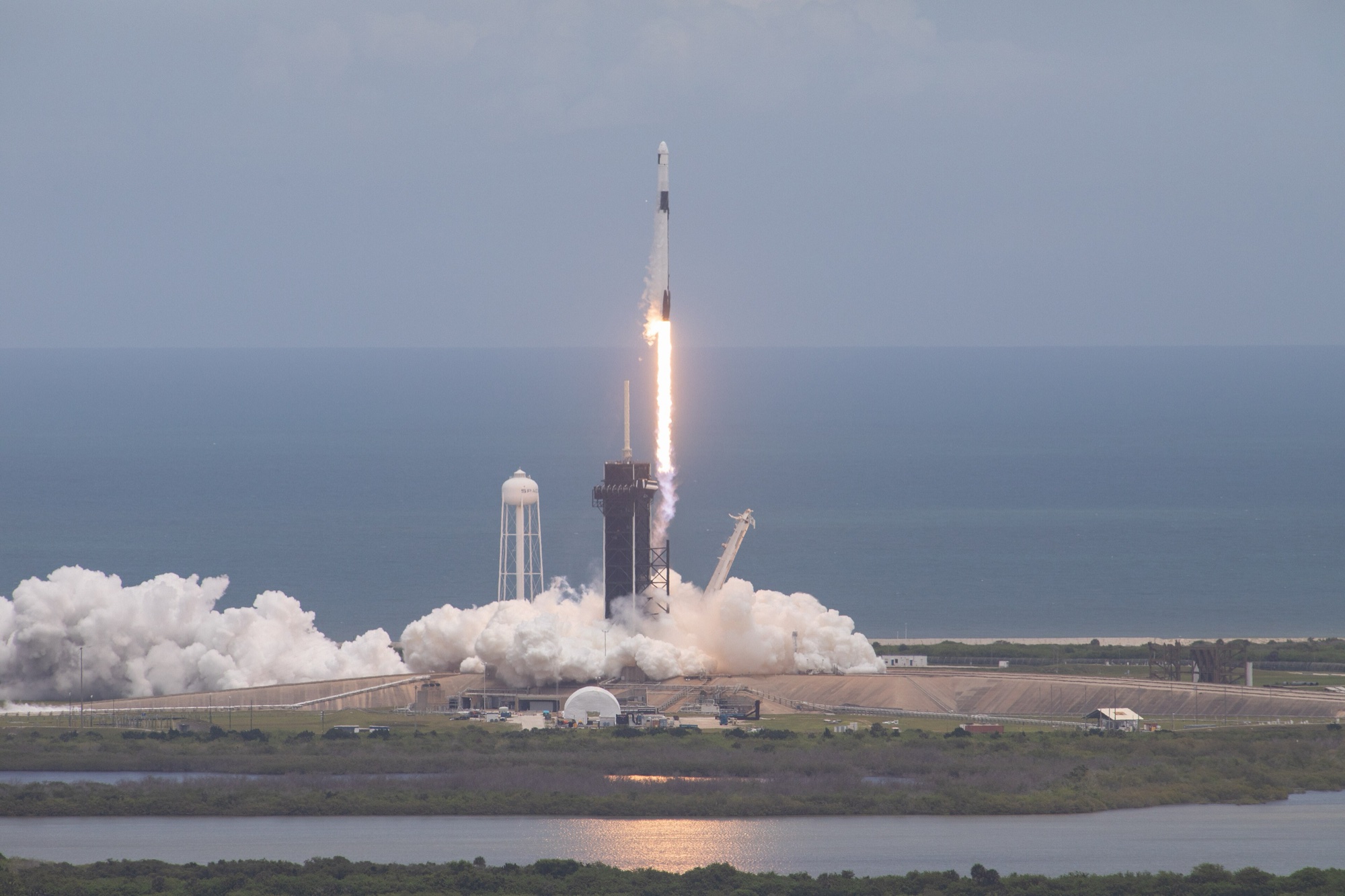
SpaceX did not just report a Starlink quarter. Space Exploration Technologies posted revenue of $14.6 billion for the three months ended 30 September 2026, up 161 percent from $5.6 billion. The exhibit is tighter than the headline: $14,575 million against $5,576 million. Divide the $8,999 million increase by $5,576 million and the result is 161.4 percent, which the release rounds to 161 percent. It is not 159 percent. The miss in the coverage is the mix. Super Intelligence, the segment previously reported as artificial intelligence, produced $7,560 million. Connectivity, which holds Starlink, produced $5,248 million. Launch, reported as Space, produced $1,767 million. Compute out-earned Starlink and did not cover its own build. Super Intelligence capital expenditure was $16,444 million. Company capital expenditure was $19,593 million, $5,018 million more than total revenue. Operating income of $2,791 million still came mostly from Connectivity, at $2,367 million.
Key facts
- Revenue was $14,575 million for the quarter ended 30 September 2026, up 161 percent from $5,576 million. The release rounds that to $14.6 billion. Source: Exhibit 99.1 to the Form 8-K filed 20 October 2026.
- Net income was $4,404 million, against a net loss of $1,054 million a year earlier. Income from operations was $2,791 million, against a loss of $273 million. Same exhibit, 20 October 2026.
- Segment revenue was Super Intelligence $7,560 million, Connectivity $5,248 million and Space $1,767 million. Super Intelligence capital expenditure was $16,444 million of company capital expenditure of $19,593 million. Same exhibit.
- Starlink consumer subscribers were 13.6 million at 30 September 2026, up from 12.0 million at 30 June and 7.2 million a year earlier. Consumer ARPU was $69 a month, against $66 and $83. Same exhibit.
- On the 20 October 2026 call, Chief Financial Officer Bret Johnsen said fourth-quarter capital expenditure should be $35 billion to $40 billion and first-quarter 2027 revenue should be $33 billion to $37 billion. Source: Motley Fool transcript.
- Cash and cash equivalents were $51,294 million and marketable securities were $38,561 million. Nine-month equipment purchases were $48,069 million. Nine-month operating cash flow was $13,097 million. Same exhibit.
- Nasdaq’s completed close for SPCX on Tuesday 20 October 2026 was $147.79, down $0.17 from Monday’s $147.96, on 117,204,900 shares. The release came after that close. Source: Nasdaq historical prices.
- SpaceX repeated the headline on X that evening: revenue of $14.6 billion, up 161 percent. Source: @SpaceX, 20 October 2026.
What just happened, and why the obvious reading is wrong
The obvious reading is that a 161 percent jump is a Starlink story with a rocket company attached. The exhibit says otherwise. Super Intelligence was 51.9 percent of the $14,575 million. Connectivity was 36.0 percent. Space was 12.1 percent. A year earlier those lines were $813 million, $3,097 million and $1,666 million. Starlink’s segment grew 69 percent, which the release states, and it was still passed on revenue.
The flip is new even against the prior quarter in the same table. For the three months ended 30 June 2026, revenue was $7,814 million, Connectivity was $4,291 million and Super Intelligence was $2,561 million. Connectivity was about 55 percent of that quarter. FinanceFeeds wrote in August that Starlink accounted for the majority of revenue when the company reported about $7.8 billion. That sentence was right for June. It is not right for September.
Spending has to be read the same way. June capital expenditure was $18,369 million, so spending beat revenue by $10,555 million. In September the excess was $5,018 million. The gap narrowed and did not close. Super Intelligence capital expenditure barely moved, from $15,828 million to $16,444 million, while its revenue went from $2,561 million to $7,560 million. Capex was 6.2 times segment revenue in June and 2.2 times in September. The compute business still spends more than it books in the same quarter.
Operating profit is a third story, and the net-income headline buries it. Connectivity income from operations was $2,367 million, up from $1,190 million, the 99 percent the release prints. Super Intelligence income from operations was $431 million, against a loss of $1,722 million a year earlier. Space income from operations was a loss of $7 million, against a profit of $259 million. Connectivity supplied 84.8 percent of company operating income. Profit stayed with Starlink.
Net income of $4,404 million is not that operating result plus a small tax line. Start at $2,791 million. Subtract interest expense of $675 million. Add interest income of $873 million and other income of $1,025 million. Pretax income is $4,014 million. A tax benefit of $390 million reaches $4,404 million. Of the interest expense, $351 million is related party. Of the other income, $561 million is related party. The release does not name the related party. A reader who stops at “$4.4 billion of profit” is counting interest, a tax benefit and a related-party line as if they were Starlink margin.
Who is exposed
The listed exposure is Nasdaq Class A stock, ticker SPCX. The balance sheet shows 8,240 million Class A shares and 5,339 million Class B shares at 30 September 2026. The close used here is Tuesday’s completed print, $147.79. The release came after the 4:00 p.m. Eastern close, so that session did not price this quarter. A FinanceFeeds report on 13 October said the largest pre-IPO lock-up step was pinned to a third-quarter earnings date the company had not yet set. That earnings report is now out.
Named customers are a launch list, not a concentration table. The release cites NASA’s Roman Space Telescope, three more ISS crew missions, 18 National Security Space Launch missions, three Starfall missions and a lunar payload on Starship. Gwynne Shotwell, President and Chief Operating Officer, added an Artemis III Starlink contract and said the new Dragon missions run through 2028. The exhibit counts 12 customer launches and 23 internal launches, 35 in total, down from 44, and mass to orbit of 476 metric tons, down from 525. Launch services revenue still rose from $1,000 million to $1,130 million, while Space research and development rose from $849 million to $1,225 million and the segment lost $7 million. The release ties the cost increase to Starship.
Starlink’s book is larger and less named. Consumer revenue was $3,121 million and enterprise and government revenue was $2,127 million, so consumer is still ahead by $994 million. The release says more than 3,800 aircraft carried Starlink at 30 September. The compute customers are the hole. Solutions and infrastructure revenue was $7,022 million. The only named piece is Cursor, bought on 14 August 2026, which added $608 million through 30 September, about 8 percent of Super Intelligence revenue. Strip it out and the segment is still $6,952 million, against $813 million a year earlier. Johnsen said that line still grew 192 percent sequentially without Cursor. The exhibit names no cloud customer and no termination right.
What the filing actually shows
The table uses the exhibit’s millions. The percent changes are the ones the release states. Unrounded, Space rose 6.1 percent, Connectivity 69.5 percent and Super Intelligence 829.9 percent. The release prints 6, 69 and 830.
| Segment | Q3 2026 revenue | Q3 2025 revenue | Change | Q3 2026 operating income | Q3 2026 capex |
|---|---|---|---|---|---|
| Space | $1,767 million | $1,666 million | +6% | $(7) million | $1,606 million |
| Connectivity | $5,248 million | $3,097 million | +69% | $2,367 million | $1,543 million |
| Super Intelligence | $7,560 million | $813 million | +830% | $431 million | $16,444 million |
| Total | $14,575 million | $5,576 million | +161% | $2,791 million | $19,593 million |
Subscriber growth and consumer revenue are not the same rate. Consumer revenue rose from $1,986 million to $3,121 million, the 57 percent the release states, while subscribers rose from 7.2 million to 13.6 million and ARPU fell from $83 to $69. Ending subscribers times $69 times three months is about $2.8 billion, below the $3,121 million consumer line. The count is a period-end stock, and the revenue line can include more than subscription ARPU.
Connectivity gross profit was about 55 percent of revenue. Johnsen said that included roughly 3 points of tariff refunds. Adjusted EBITDA was $3,499 million, up from $1,923 million. Super Intelligence’s $431 million of operating income sits under $2,675 million of cost, $3,183 million of research and development, and $1,268 million of overhead. The exhibit includes $1,217 million of Cursor stock pay in that result. Johnsen said that excluding the charge, operating profit was $1.6 billion. Adjusted EBITDA of $4,953 million is not the $16,444 million of capital expenditure.
Nine-month revenue was $27,083 million and the net loss was $413 million, or $1,084 million attributable to shareholders. The quarter’s $4,404 million did not pull the nine-month shareholder result into profit. September was 53.8 percent of nine-month revenue. Cash from operations was $13,097 million and equipment purchases were $48,069 million, so one quarter of capital expenditure already exceeds nine months of operating cash flow. Cash and securities sum to $89,855 million. Debt sums to $38,844 million, of which $12,897 million is related party. IPO proceeds were $85,675 million. The cash pile is the offering, not retained profit.
What management said, and what it did not
Bret Johnsen, Chief Financial Officer, opened the 20 October call with the line the release leaves unsigned: “Revenue grew an impressive 161% year-over-year to $14.6 billion, fueled by the continued momentum in the connectivity business and our clear inflection point in the Super Intelligence or SI business.” He then gave the outlook the exhibit does not contain. Fourth-quarter capital expenditure of $35 billion to $40 billion. First-quarter 2027 revenue of $33 billion to $37 billion. A goal of $100 billion of annualized revenue by the end of 2026, “defined as annualized revenue based on the month of December.”
Those three figures are not one forecast. September annualizes to about $58.3 billion if you multiply the monthly average by twelve. December would need about $8.3 billion, 1.7 times the September monthly pace of about $4.9 billion, to annualize to $100 billion. The first-quarter range is 2.3 to 2.5 times September. He tied it to the compute pipeline over the next six months. He put backlog at $63 billion, about $42 billion of it due within a year, with $17.5 billion already deferred. The balance sheet’s deferred revenue, $10,784 million plus $6,736 million, is $17,520 million. A $33 billion first quarter would consume most of that twelve-month book at once, so the guide needs new contracts. He said new capacity pays back in under a year. This quarter’s segment capex is still 2.2 times segment revenue.
Gwynne Shotwell put the aviation book in one sentence: “Starlink is now contracted for roughly 12,000 planes, almost 1/4 of the available aircraft, and we’re expanding quickly with both new and existing customers.” She named Lufthansa, Swiss, Copa, Korean Air, Austrian and Asiana as first flights in the quarter, and said three of the four major U.S. carriers are signed. She also said Grok Bot had 800,000 paid weekly users earlier in October. That count is after the quarter and is not a revenue line. Advertising revenue in the exhibit was $538 million, against $454 million.
Elon Musk, Chief Executive Officer, then used a number his finance chief had not. “I mean in a nutshell, what this implies for SpaceX annual recurring revenue by the end of ’27 is somewhere between $500 billion and $1 trillion.” That is an end-2027 ARR band, not the December 2026 test, and not his later post. At 22:05 UTC on 20 October he wrote: “As crazy as this sounds, $1T in SpaceX revenue in 2028 is no longer impossible.” On a Tesla combination he said both boards have special committees, that he is conflicted and not in the talks, and that “the special committees have not reached agreement on the terms of any transaction.” The exhibit does not mention a merger.
No cloud customer was named, no guide is in the 8-K, and no quarterly operating cash flow was published. Johnsen called the balance sheet investment grade. The exhibit attaches no rating letter and names no chip supplier. FinanceFeeds reported on 8 October that talks about roughly $40 billion for Nvidia chips were unsigned. This filing does not confirm them, and the call did not name Nvidia.
Spectrum, power and the bill for the build
The regulatory item in the exhibit is spectrum, not a launch license. On 8 October 2026 the company agreed to buy up to 14 megahertz of paired 800 MHz spectrum, with closing expected in the first half of 2027 and no price in the release. Shotwell said the FCC has cleared 15,000 mobile V2 satellites and that U.S. service is an early-2028 project. She said Starlink Mobile had 22 million monthly users, up 37 percent. That is not U.S. carrier revenue. The same night Musk wrote that cellular veterans “look at the chess board of existing pieces and don’t see a solution.” That post is an argument, not a subscriber count.
Starship is the capacity tool for the satellites. The release says Flight 14 was the first revenue-generating Starship mission and deployed 26 V3 satellites, about ten times a Falcon 9 Starlink launch. FinanceFeeds reported that flight when the next session rose 2.6 percent. Nameplate compute was 1.7 gigawatts, up from 0.6 a year earlier. Johnsen said nearly 2.2 gigawatts by the end of October and 2.5 to 3 by quarter-end. Musk said roughly 200,000 GB300s a month are coming online. A secondary write-up cut that pace by ten. He said 200,000. Add a $35 billion to $40 billion fourth quarter to nine-month capex of $48,069 million and 2026 spending is about $83 billion to $88 billion if the guide is met.
What happens next
By 31 October 2026 the first check is physical. Johnsen said nameplate compute should be nearly 2.2 gigawatts, up from 1.7 on 30 September. If an update does not show that step, the fourth-quarter capex range is spending running ahead of the capacity he described. If it does, the revenue still arrives later. He said the payback is measured in months, not in the same week’s sales.
In November 2026 Musk said Flight 15 should fly, with an attempt to catch the booster and the ship. He did not promise the catch. The revenue chain runs through Starlink capacity, not through a ticket on the attempt. Shotwell tied V3 satellites and Starship cadence to sales in busy markets. A miss leaves Flight 14’s 26 satellites as the operational proof. A catch does not, by itself, move the $7,560 million.
On 31 December 2026 two of his tests come due: 2.5 to 3 gigawatts of compute, and December revenue near $8.3 billion if the $100 billion annualized goal is literal. The first-quarter range of $33 billion to $37 billion is the later test. Another 69 percent on Starlink’s $5,248 million would add about $3.6 billion, not $18 billion. The range needs the compute pipeline. If that pipeline slips, the capex will already have been spent.
This is not financial advice.
Frequently asked questions
Is the 161 percent revenue jump a Starlink story or a compute story?
It is a compute story on the top line and a Starlink story in operating profit. Super Intelligence revenue was $7,560 million, ahead of Connectivity at $5,248 million, but Super Intelligence capital expenditure was $16,444 million. Connectivity produced $2,367 million of operating income, most of the company’s $2,791 million. The release states 161 percent, from $5,576 million to $14,575 million, not 159 percent.
Why does a 159 percent figure keep showing up?
The release, the earnings call and the company’s own X post all say 161 percent. The exhibit’s lines are $14,575 million and $5,576 million. The increase of $8,999 million is 161.4 percent of the year-ago figure, which rounds to the printed 161 percent. A 159 percent reading does not match those two numbers. This piece uses the 20 October 2026 filing, not a rounded pair that produces a different rate.
Did Starlink stop growing?
No. Connectivity revenue rose 69 percent to $5,248 million. Consumer subscribers reached 13.6 million, from 7.2 million a year earlier and 12.0 million in June, and consumer revenue rose 57 percent. Monthly ARPU was $69, up from $66 in June and down from $83 a year earlier, so the user base grew faster than revenue per user. The segment also earned $2,367 million of operating income. It was passed on revenue, not on profit.
How can net income be $4.4 billion if capital spending was $19.6 billion?
Capital expenditure is not an operating expense in the quarter it is spent. It is added to the balance sheet. Operating income was $2,791 million. Net income of $4,404 million is higher because the quarter also included $873 million of interest income, $1,025 million of other income and a $390 million tax benefit, against $675 million of interest expense. Cash is separate. Nine-month operating cash flow was $13,097 million, against $48,069 million of equipment purchases.
What did SpaceX actually guide, and where is the guide?
The 8-K exhibit prints neither a revenue outlook nor a capital-expenditure outlook. On the 20 October call, Bret Johnsen said fourth-quarter capital expenditure should be $35 billion to $40 billion, and first-quarter 2027 revenue $33 billion to $37 billion. He also repeated a goal of $100 billion of annualized revenue by the end of 2026, defined as December revenue times twelve. Those sentences are on the call. They are not a line in the filed exhibit.
Did Tuesday’s stock close price this quarter?
No. Nasdaq’s daily history shows Class A shares closed at $147.79 on Tuesday 20 October 2026, down $0.17 from Monday’s $147.96, on 117,204,900 shares. The company posted the release after that close. A Wednesday print, including any pre-market trade, is not a completed session and is not the close used here. The cash tape that lines up with the filing is still Tuesday until Wednesday’s regular session ends.